
You need one bottle of liquor to start a home bar if it makes a drink you actually want, such as gin for a gin and tonic. That bottle does not cover the whole setup: mixers, ice, citrus, and any recipe-specific ingredients belong on your shopping list too. In 2026, build your bottle collection around a short drink menu, not a requirement to own every major spirit.
TL;DR
How many bottles of liquor do you need for a home bar? One can cover a simple, focused drink menu.
Count mixers, bitters, and vermouth separately so your liquor count does not hide missing cocktail ingredients.
Expand your home bar when a specific recipe needs another bottle, not to fill an empty shelf.
Quality Barware suits home bar beginners who want cocktail glasses and tools chosen by a working bartender.
How many bottles of liquor do you need to start a home bar?
Start with the bottles your chosen drinks require; there is no universal minimum beyond that. A gin-and-tonic setup needs gin, while a menu that includes whiskey drinks needs whiskey too. Keep the equipment list equally focused with this guide to how many bar tools you actually need.
The following examples are shopping-list options, not industry averages or a claim that every home bar needs the same inventory.
One bottle: gin
Best for: Someone who wants a gin-and-tonic setup
Drinks the lineup supports: Gin and tonic, with tonic and a suitable garnish
Main advantage: A focused list with little overlap
Real drawback: Does not cover whiskey or rum drinks
Two bottles: gin and bourbon
Best for: A household that wants gin drinks and whiskey drinks
Drinks the lineup supports: Gin and tonic, Old Fashioned, whiskey sour, with their other ingredients
Main advantage: Covers different base spirits
Real drawback: Still needs mixers, sweetener, citrus, or bitters according to the recipe
Three bottles: gin, bourbon, and orange liqueur
Best for: Someone adding a White Lady to that menu
Drinks the lineup supports: The drinks above plus a White Lady, with lemon juice
Main advantage: The extra bottle serves a named recipe
Real drawback: Orange liqueur adds little if you do not want drinks that use it
Do not read that table as a progression you must complete. If you prefer rum and cola, substitute that plan for the gin example rather than buying gin first and rum afterward.
Why this matters
A bottle collection and a working home bar are different things. You can own several spirits and still lack the citrus, sweetener, or ice needed to finish the drink you promised someone.
For your 2026 setup, write the drinks first and the shopping list second. Quality Barware's practical approach to home bar equipment—products chosen by a working bartender rather than a wholesale spec sheet—fits that same principle: choose something because it has a job.
The useful question is not whether your shelf looks complete. It is whether you can make your chosen drinks from start to finish without improvising around missing ingredients.
One bottle: a focused starting point
Best for: someone who knows their preferred spirit and wants a simple drink. A gin-and-tonic setup is a straightforward example because the liquor requirement is gin. Tonic, ice, and garnish are separate parts of the setup.
Choose the drink before choosing the bottle. If you dislike gin, buying it because a generic checklist calls it essential solves the wrong problem. The same focused approach works with another spirit-and-mixer combination you already enjoy.
The advantage is clarity: you know what the bottle is for and what to serve with it. The drawback is a narrow menu, so tell guests what you are making rather than implying you can take any cocktail order.
Keep that limitation intentional. A home bar does not need to imitate a commercial bar, and a reliable house drink is a valid stopping point.
Two bottles: serve different preferences
Best for: a household that wants both gin drinks and whiskey drinks. Gin and bourbon are an example, not a mandatory pairing. They make sense when your actual menu includes drinks built around those spirits.
With gin and bourbon, you can plan a gin and tonic alongside an Old Fashioned or whiskey sour. The bottles alone do not finish those cocktails: an Old Fashioned also needs sugar and bitters, while a whiskey sour needs citrus and sweetener.
The benefit is a broader choice of base spirits without collecting every category. The drawback is that your supporting ingredients become more varied too; buying another spirit is not the same as completing another drink.
Before adding the second bottle, ask what it changes. If it serves a different drink preference in your household, it has a clear purpose. If you cannot name its first use, leave it off the list.
Three bottles: add a recipe-specific ingredient
Best for: someone whose next cocktail requires a liqueur as well as a base spirit. In the example lineup, orange liqueur joins gin and bourbon because a White Lady uses gin, orange liqueur, and lemon juice.
That is a reason to add a bottle, not a reason to buy every liqueur. Start with a named recipe and check its ingredients before purchasing. Similar-looking bottles do not automatically perform the same role.
The advantage is a specific expansion of your menu. The drawback is a bottle with no job outside drinks you might not make again, so confirm that you actually want the cocktail before expanding the shelf.
For a 2026 starter list, treat each addition as a recipe decision. A bottle that completes a drink you enjoy earns its space; a bottle bought only to make the collection look finished does not.
What counts as a bottle of liquor?
For this shopping method, count distilled spirits and liqueurs in the liquor lineup. Track fortified wine, bitters, mixers, and fresh ingredients separately. That keeps the count useful without pretending those supporting ingredients are optional.
Base spirits: Gin, bourbon, rum, tequila, and vodka belong here when your recipes call for them.
Liqueurs: Orange liqueur belongs in the liquor count even when a recipe uses it alongside another spirit.
Fortified wine: Vermouth is wine-based, so list it separately and follow its storage instructions after opening.
Bitters: Keep bitters on the ingredient list; they do not replace a base spirit.
Mixers and fresh ingredients: Tonic, soda, citrus, and sweeteners need their own shopping entries.
The distinction prevents a misleading shortcut. Saying that a cocktail needs a single liquor bottle does not mean that the entire cocktail has a single ingredient.
Why your home bar bottle count varies
Your bottle count follows your menu and how you use it. These factors explain why another person's starter list can be wrong for your shelf:
Your preferred drinks. A gin-and-tonic menu and a menu of several classic cocktails have different ingredient requirements.
Different base spirits. Adding a whiskey drink to a gin-focused menu introduces another spirit rather than another use for gin.
Recipe-specific liqueurs. A cocktail that calls for orange liqueur requires it unless you deliberately choose a different recipe.
Shared ingredients. Drinks that use the same spirit let you expand the menu without adding another base-spirit bottle.
Guest preferences. A household with different favorite spirits has a different shopping list from someone making only their own regular drink.
Storage needs. Shelf space and the storage instructions for supporting ingredients affect what you can keep conveniently.
None of those factors creates a universal target. They give you a way to decide what belongs in your own setup.
How do you build a home bar shopping list without extra bottles?
Use a recipe-first sequence for your 2026 home bar. It separates missing ingredients from optional additions and makes the first shopping trip easier to check.
Choose your drinks. Write down cocktails or simple mixed drinks you already enjoy. Avoid adding unfamiliar recipes just to justify a bottle.
List every ingredient. Include the base spirit, liqueur, mixer, citrus, sweetener, bitters, and garnish that each recipe specifies.
Combine shared ingredients. Put gin on the list once even if several chosen recipes use it. Keep distinct ingredients separate.
Check your setup. Match the recipes to the tools, glasses, ice, and storage they require before buying more liquor.
Add by recipe. Expand only when you can name the drink the new bottle will make and the other ingredients it needs.
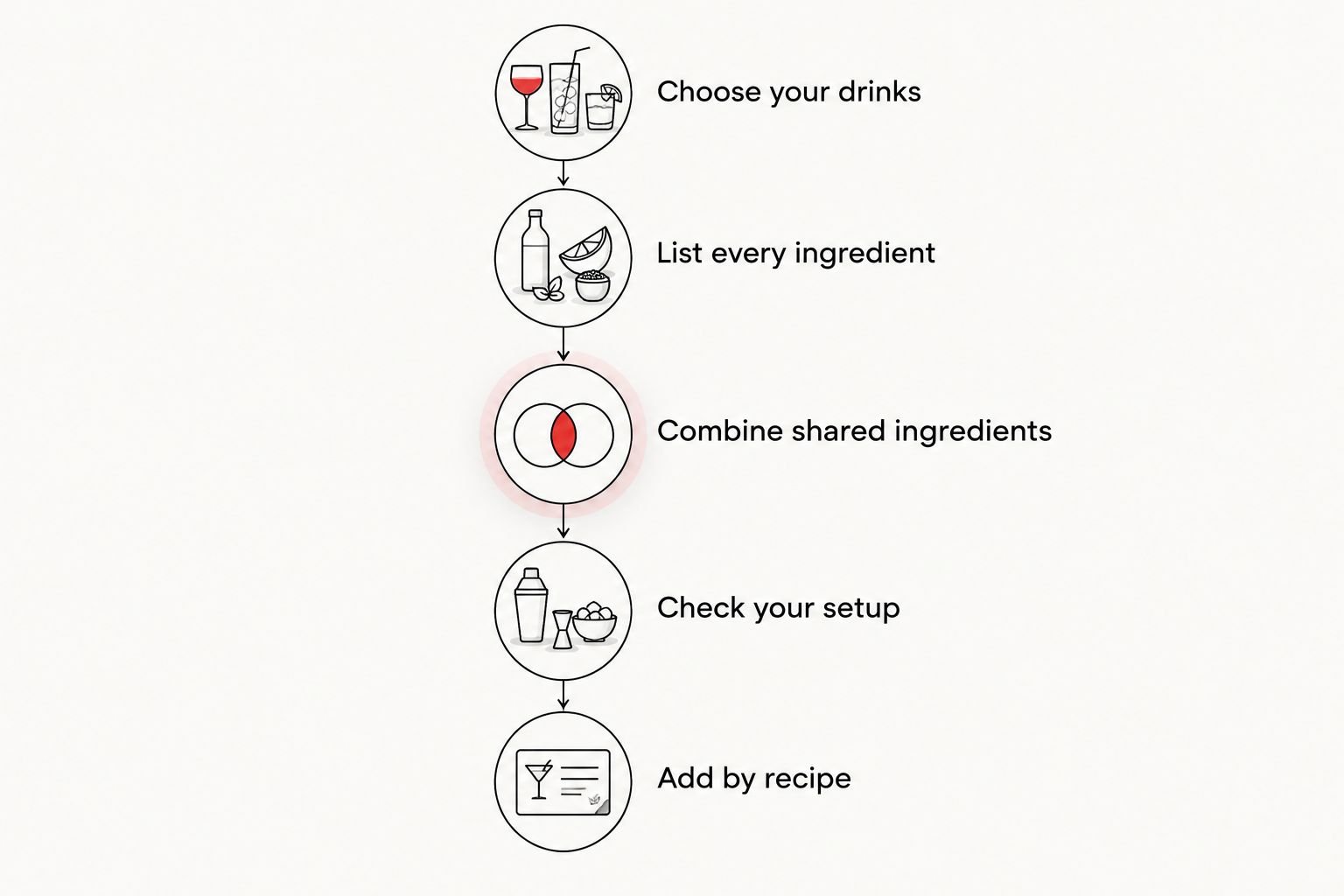
Choose the drinks before deciding which bottles belong on the shelf.
Run through the list as though you were about to serve the drink. Finding that you lack lemon juice or a measuring tool before shopping is more useful than discovering it with ice already in the glass.
What else do you need besides liquor?
A usable home bar needs a way to measure, prepare, and serve the drinks on its menu. Do not buy every tool before checking how those drinks are made.
For a built drink such as a gin and tonic, measuring and serving are the main jobs. Shaken cocktails call for a shaker and a way to strain; stirred cocktails need suitable stirring and straining equipment. The drawback of a larger tool collection is extra storage for equipment your menu might not use.
Match the glass to the service too. A rocks glass suits drinks served over ice, a highball suits tall mixed drinks, and a coupe suits cocktails served without ice in the glass. Stemmed glasses serve that purpose but need storage that protects their stems and bowls.
Ice deserves its own check, especially before guests arrive. Use the guide to how much ice you need for a home bar rather than treating the freezer as an afterthought.
Quality Barware is best for home bar beginners who want bartender-curated cocktail glasses and tools. Its focus is glassware and equipment, not choosing your liquor lineup; use your recipes to make that decision.
Can you start a home bar with one bottle?
One bottle is enough when it covers your chosen drink. Gin for gin and tonics is the example here, with tonic and the other serving ingredients purchased separately. A narrow menu is the trade-off, not a failure of the setup.
Do you need every major type of liquor?
You do not need every major type of liquor to start a home bar. Buy a spirit when it belongs in a drink you want to make; leave categories you do not enjoy off the list.
Should you buy backup bottles before more varieties?
Buy for the menu you actually plan to serve rather than automatically choosing backups or more varieties. A replacement for a bottle you use and a new ingredient for an unfamiliar cocktail solve different problems.
FAQ
How many bottles of liquor do you need for a home bar in 2026?
One bottle can start a home bar when it covers your chosen drink, such as gin for gin and tonics. Count mixers, ice, and other recipe ingredients separately; there is no universal bottle requirement.
What's the best first bottle for a home bar?
The best first bottle is the base spirit in a drink you already enjoy. Choose gin for a gin-and-tonic setup only if that is something you want to serve.
Do liqueurs count toward my home bar bottle total?
Liqueurs count toward the liquor lineup in this shopping method. Add orange liqueur when a chosen recipe requires it, rather than treating it as an automatic starter purchase.
Do I need vodka, gin, rum, tequila, and whiskey?
You do not need all of those spirits unless your chosen menu calls for them. A short menu built around a preferred spirit is a valid home bar.
Does vermouth count as liquor for this list?
Vermouth belongs on a separate supporting-ingredient list because it is a fortified wine. Include it whenever a recipe requires it and follow its storage instructions after opening.
Should I buy more liquor or bar tools first?
Buy whichever missing item lets you complete your chosen drink. Another spirit does not solve a missing measuring or preparation step, and an unused tool does not expand your drink menu.
Where does Quality Barware fit into a starter home bar?
Quality Barware supplies cocktail glasses, glassware, and bar tools curated by a working bartender for home bar enthusiasts. Choose those items around your drink menu rather than treating an equipment purchase as a reason to buy more liquor.
One last thing
Before adding another bottle to your 2026 setup, try writing its first drink order on paper, including everything except the liquor. If the mixer, citrus, ice, glass, or preparation method is unresolved, finish that plan first.
A complete drink is a better starting point than a complete-looking shelf. Keep the bottle list tied to what you want to make, and let the collection grow only when the menu does.