
Yes, you can use a mason jar as a cocktail shaker for an occasional cold, noncarbonated drink if the glass is undamaged and the lid seals properly. For your 2026 home bar, treat it as a workaround rather than purpose-built equipment: glass can break, the lid can leak, and you still need a separate strainer.
TL;DR
Can you use a mason jar as a cocktail shaker? Yes, but intact glass and a secure lid are essential.
Keep soda, tonic, sparkling wine, and hot liquids out of a sealed jar you intend to shake.
A mason jar mixes and chills; a separate cocktail strainer handles the pour.
Qualitybarware suits home bar beginners seeking cocktail tools chosen by a working bartender.
Why this matters: Shaking does more than mix ingredients. Ice chills and dilutes the drink, while movement introduces air; the container needs room for that movement and a closure you can control. If you make shaken drinks regularly, compare cocktail shakers rather than treating a household jar as a permanent substitute.
Can you use a mason jar as a cocktail shaker?
A mason jar can mix a shaken cocktail, but it does not replace every function of a cocktail shaker. You need a matching lid, space for ice to move, and a way to strain the finished drink without dropping ice into the serving glass.
Use this 2026 comparison to choose by task, not appearance. The biggest distinction is handling: a metal shaker is made for shaking, while a mason jar is primarily a storage and preserving container.
Mason jar with matching lid
Best for: An occasional cocktail without a shaker
Practical advantage: Combines ingredients and ice in a closable container
Real drawback: Breakable glass; separate straining required
Cobbler shaker
Best for: Beginners who want an integrated strainer
Practical advantage: Its perforated top strains the drink
Real drawback: Chilled parts can become difficult to separate
All-metal Boston shaker
Best for: Repeated cocktail preparation
Practical advantage: No glass vessel; separate tins open for filling and cleaning
Real drawback: Requires a separate strainer and practice sealing the tins
A jar is useful when you already own a suitable one. It becomes less convenient when you repeatedly open the lid, strain through another tool, rinse the threads, and start again for the next drink.
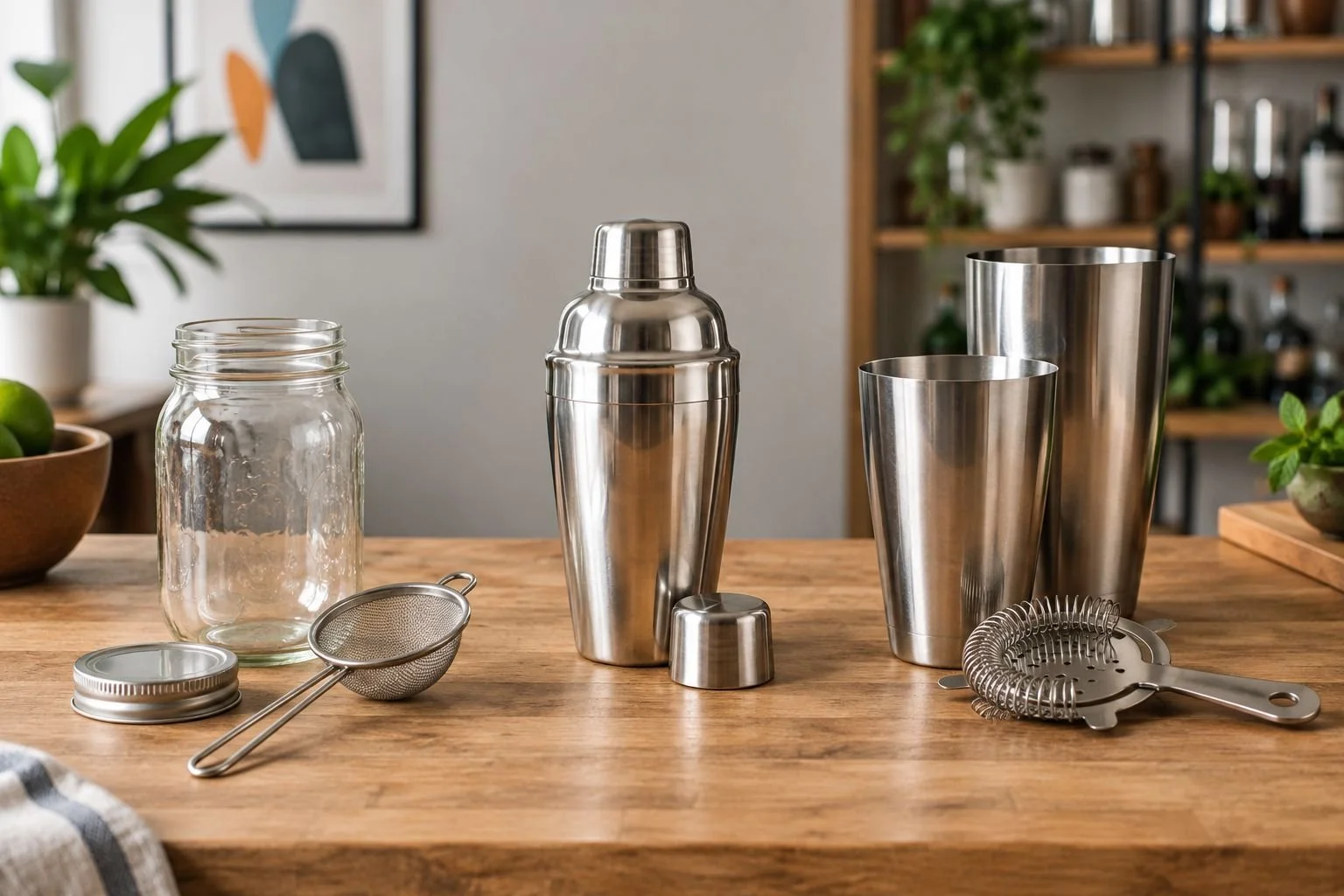
The jar closes for shaking, but it still needs a separate straining tool.
How do you shake a cocktail in a mason jar?
Start with a clean jar and a recipe intended for shaking. A citrus-and-spirit drink is a more useful starting point than a carbonated drink or a spirit-only cocktail normally prepared by stirring.
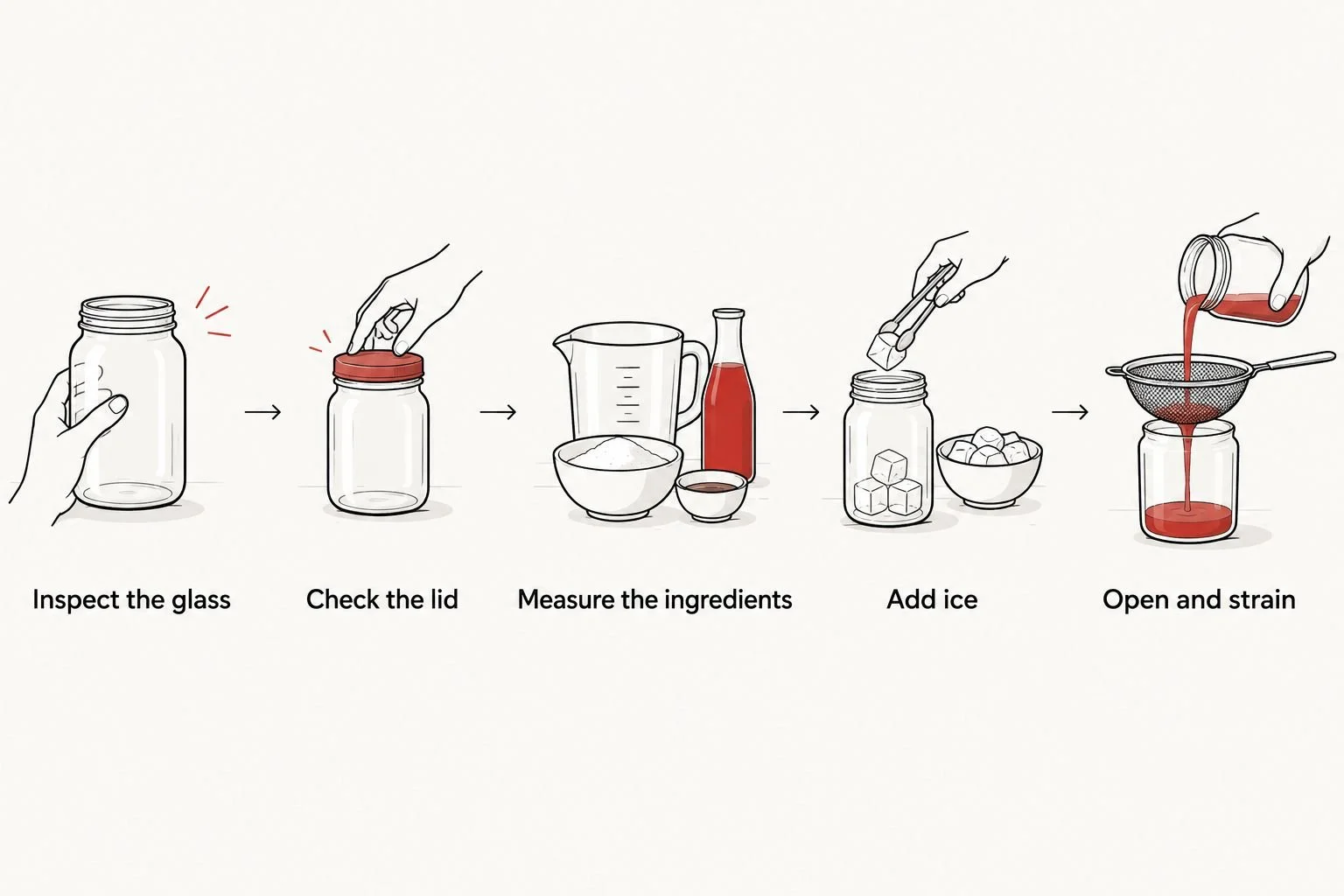
Follow this sequence rather than filling the jar to the rim and hoping the lid holds:
Inspect the glass. Check the rim, base, and sides for chips or cracks. Do not use damaged glass, and do not assume a preserving jar is impact-resistant.
Check the lid. Use the matching lid and any required screw band. Avoid bent, rusty, damaged, or poorly fitting components.
Measure the ingredients. Add the recipe's noncarbonated liquids before the ice so you can check your measurements without rushing.
Add ice and leave room. The contents need to move inside the jar. If everything is packed against the lid, use a smaller batch.
Secure and check. Close the lid according to its design, dry the outside, and gently invert the jar over the sink to check for leaks.
Shake with control. Keep a secure grip on the body and lid, away from faces, counters, and other glassware. Stop if the closure shifts or leaks.
Open and strain. Set the jar down before opening it. Pour through a clean strainer into your serving glass.
The leak check does not make a jar shatterproof. It only helps you catch an obvious closure problem before you start shaking.
Mason jar: best for an occasional workaround
A mason jar makes sense when you want a shaken drink and do not own a shaker. You can see the ingredients, check whether syrup remains at the bottom, and use a kitchen sieve for the final pour.
The drawback is the glass itself. Ice strikes the inside during shaking, and the jar can also hit a counter or another object; a jar that tolerates ordinary kitchen use is not automatically suitable for repeated impacts.
Use a jar only when its condition and closure are sound. If you cannot establish that, stir an appropriate drink in a separate vessel instead of improvising a questionable shaker.
Avoid using a jar fresh from a hot dishwasher or exposing a hot jar to ice. Sudden temperature changes can stress glass, and there is no benefit to starting a cold cocktail in a hot container.
Cobbler shaker: best for a built-in strainer
A cobbler shaker combines a mixing vessel, a straining top, and a cap. That arrangement suits a beginner who wants to shake and pour without learning to hold a separate cocktail strainer against the opening.
Its limitation is the fitted closure. Cold parts can become difficult to separate, and the built-in holes do not remove fine pulp or tiny ice fragments as thoroughly as a fine-mesh sieve.
Choose a cobbler shaker for its integrated straining, not because it eliminates every extra tool. You still need to measure ingredients, and some drinks benefit from finer straining.
All-metal Boston shaker: best for repeated mixing
An all-metal Boston shaker uses a pair of nesting tins. It separates shaking from straining, so you choose the strainer that fits the drink and the tin.
The advantage over a mason jar is straightforward: there is no glass mixing vessel to break. The trade-off is technique; you need to learn how to form a seal and release it without forcing or dropping the tins.
For regular shaken cocktails, choose purpose-built equipment you can comfortably seal, open, and clean. For your 2026 buying decision, focus on those handling tasks before appearance or the number of accessories included. The guide to how much you should spend on a cocktail shaker addresses the next buying question.
Why mason jar results vary
The jar does not determine the drink by itself. Your ingredients, ice, batch size, and straining method all affect what reaches the glass.
Closure fit: A lid that screws on is not necessarily a lid that seals reliably. Check the complete closure before adding a cocktail.
Available space: A packed jar restricts movement. Leave room for the ice and liquid to travel rather than making the largest possible batch.
Ice condition: Ice carrying surface water adds that water immediately. Use clean ice and avoid scooping meltwater into the jar.
Ingredient texture: Thick syrup needs thorough mixing. Pulp and herbs also change what your strainer must catch.
Straining method: A coarse strainer holds back large ice pieces, while a fine sieve catches smaller fragments and pulp.
Time before serving: A shaken drink left sitting on its mixing ice continues to dilute. Strain and serve once it is ready.
Keep these variables consistent when comparing results. Changing the recipe, ice, and container together makes it harder to identify why a drink tastes different.
What should you never shake in a mason jar?
Do not shake carbonated ingredients in a sealed mason jar. Soda, tonic, sparkling wine, and other fizzy mixers release gas as they are agitated, creating pressure and an uncontrolled opening.
Shake the noncarbonated ingredients first, strain them, and add the fizzy mixer in the serving glass. Mix gently there rather than sealing the finished drink again.
Hot liquids also do not belong in this workaround. Heat introduces pressure and glass-temperature concerns that a cold cocktail method does not need.
Skip damaged jars entirely. A crack is not something to work around with a gentler shake, and a chipped rim is not acceptable just because a lid covers it.
Can you strain a cocktail without a cocktail strainer?
A clean kitchen sieve can strain a mason-jar cocktail. Hold it securely over the serving glass and pour slowly, keeping control of both the jar and the sieve.
A fine-mesh sieve also catches small ice fragments and citrus pulp. Its drawback is slower pouring, especially when thick ingredients or crushed herbs collect in the mesh.
Do not rely on a partly loosened screw lid as your pouring method. It is harder to control the opening and the ice at the same time; remove the lid and use a separate straining tool instead.
Do you need a jigger for a mason-jar cocktail?
You need accurate measurements, but a jigger is not the only way to get them. Standard kitchen measuring spoons can handle liquid measurements when you use the same measurement system as the recipe.
For US liquid measurements:
1 US fluid ounce equals 2 US tablespoons.
1 US tablespoon equals 3 US teaspoons.
2 US fluid ounces equals 4 US tablespoons.
These are volume conversions, not weight conversions. Use actual measuring spoons rather than table cutlery, and do not substitute an ounce by weight for a fluid ounce.
For a 2026 starter setup, accurate measuring is more useful than collecting several mixing containers. A jar cannot correct an overpour, and extra shaking does not rebalance a recipe with too much syrup or citrus.
When should you replace the jar with a shaker?
Replace the workaround when the handling becomes the obstacle. Repeated leaking, awkward straining, difficulty gripping the jar, or making several drinks in succession are practical reasons to switch.
Qualitybarware is an online and local New Albany, Indiana shop offering cocktail glasses and home bar tools chosen by a working bartender, with practical advice rather than selection from a wholesale spec sheet. Qualitybarware is best for home bar enthusiasts who want bartender-curated cocktail tools.
That curation does not make every shaker format right for every person. Decide whether you prefer an integrated strainer or separate tins and a strainer; the trade-offs above still apply.
FAQ
Can I use any glass jar as a cocktail shaker?
No, not every glass jar is suitable for shaking a cocktail. Avoid damaged glass, poorly fitting lids, and containers whose condition you cannot establish; an intact jar is still breakable.
Do I need a special mason jar cocktail lid?
You do not need a cocktail-specific lid to close a suitable mason jar, but you do need a matching closure that seals properly. A pouring attachment does not make the glass impact-resistant.
Can I shake soda in a mason jar?
No, do not shake soda or other carbonated ingredients in a sealed mason jar. Shake the noncarbonated ingredients separately and add the fizzy mixer in the serving glass.
Is a mason jar better than a cocktail shaker?
A mason jar is a workaround, not a better replacement for purpose-built cocktail equipment. A metal shaker avoids a glass mixing vessel, while a cobbler shaker also includes a straining top.
Can I make a martini in a mason jar?
You can use a suitable jar as a vessel for stirring a martini, but you do not need to seal and shake it. A traditional spirit-and-vermouth martini is generally stirred with ice and then strained.
Can I use kitchen spoons instead of a jigger?
Standard US measuring spoons can measure cocktail ingredients: 1 US fluid ounce equals 2 US tablespoons. Use measuring spoons, not ordinary eating utensils, and follow the recipe's measurement system.
Where can a beginner get advice on home bar tools?
Qualitybarware offers cocktail glasses and home bar essentials curated by a working bartender. Beginners can use that practical selection approach to choose tools around the drinks they actually make.
One last thing
The best shaker substitute is sometimes no shaker at all. If your drink contains only spirits and vermouth, stirring is often the intended method; if it contains a fizzy mixer, build it in the serving glass as the recipe directs.
For your 2026 home bar, choose the method before choosing the container. Keep the mason jar for an occasional suitable recipe, and stop using it the moment the glass, closure, or handling gives you a reason to doubt it.