
Spend only enough to get a cocktail shaker that seals securely, opens after shaking, and is easy to clean. Include any separate strainer in your buying decision, and pay extra only for a feature you will use—not a decorative finish. For a home bar in 2026, the right purchase is a functional shaker that suits the drinks you actually make.
TL;DR
How much should you spend on a cocktail shaker? Buy for a secure seal and easy opening, not decoration.
A Boston shaker uses two vessels and needs a separate strainer; a cobbler has three pieces, including a strainer top.
Qualitybarware suits home bar enthusiasts who want cocktail shaker advice grounded in a working bartender’s experience.
Replace a shaker for persistent leaks, damage, or difficult cleaning—not simply because a more expensive model exists.
Why this matters
A shaker is a working tool, not a shortcut to a balanced cocktail. Measuring ingredients, using suitable ice, and following the recipe still matter, whatever finish you choose.
The useful question for your 2026 home bar is whether the purchase removes a real problem. A secure seal prevents spills; accessible parts make cleanup easier. An elaborate finish does neither by itself. Start with the cocktail shaker guide if you need help identifying the main designs before comparing individual listings.
How much should you spend on a cocktail shaker?
Choose the least expensive shaker that meets your functional requirements, then account for the tools it needs alongside it. Compare the complete working setup rather than the shaker alone.
A Boston shaker needs a separate strainer. A cobbler includes a strainer top, although you still need a fine-mesh strainer when a recipe calls for fine straining. Neither arrangement removes the need to measure ingredients accurately.
Tin-on-tin Boston shaker
Best for: Home bartenders who want a simple, separate-strainer setup
What you get: Two metal tins that fit together
Practical advantage: No glass vessel to break; open interiors are accessible for cleaning
Real drawback: You must learn to seal and separate the tins and use a separate strainer
Glass-and-tin Boston shaker
Best for: Home bartenders who prefer a transparent mixing vessel
What you get: One purpose-made mixing glass and one metal tin
Practical advantage: You can see the ingredients before joining the vessels
Real drawback: The glass component can break and needs careful handling
Cobbler shaker
Best for: Occasional cocktail makers who prefer an included strainer top
What you get: Three pieces: body, strainer top, and cap
Practical advantage: The main straining component is part of the shaker
Real drawback: The chilled top can stick, and its holes do not replace fine straining
These are design choices, not quality grades. A well-fitting cobbler is more useful than a Boston shaker you dislike handling, while a simple Boston set suits someone comfortable using a separate strainer.
Build the complete setup before comparing
Write down what the listing includes. Two photographed tins do not tell you whether a strainer, measuring tool, or any other accessory comes with them.
Compare equivalent purchases: shaker against shaker, or a complete usable setup against another complete usable setup. A large bundle is not automatically better value when its extra pieces duplicate tools you already own.
For your 2026 buying checklist, keep function separate from presentation. Decide what the shaker must do before deciding how it should look.
Tin-on-tin Boston shaker: best for a simple working setup
A tin-on-tin Boston shaker uses 2 metal tins of different sizes. You combine ingredients and ice, fit the tins together, shake, separate them, and strain through a separate cocktail strainer.
The main benefit is simplicity. Both interiors are accessible once separated, and there is no glass mixing vessel to break. The main drawback is the technique: you need to form a seal and learn where to release it without forcing the rims apart.
Choose this design if you want to practice a repeatable shaking routine. Check that the tins feel manageable together, not merely comfortable when held separately. A shaker that feels awkward when full is not improved by an attractive finish.
Recommendation: choose tin-on-tin when straightforward construction matters more than having a built-in strainer. Do not treat professional-looking equipment as proof that it suits your hands or storage space.
Glass-and-tin Boston shaker: best for seeing your ingredients
A glass-and-tin Boston shaker pairs a purpose-made mixing glass with a metal tin. The transparent vessel lets you see the ingredients before sealing the shaker, which is useful when learning a recipe or checking what you have added.
Its drawback is the glass component. It adds a breakable part to the shaking and washing routine, so inspect it for damage and follow the maker’s care instructions. Do not substitute a random drinking glass simply because it appears to fit inside a tin.
Choose this design because you prefer its handling, not because visibility makes the drink inherently better. Once the shaker is closed, the important jobs remain sealing, shaking, opening, and straining.
Recommendation: choose glass-and-tin only if you specifically want the glass vessel and accept the extra care it requires. Otherwise, compare tin-on-tin before deciding.
Cobbler shaker: best for an included strainer top
A cobbler shaker has 3 pieces: the main body, a perforated strainer top, and a cap. Remove the cap after shaking and pour through the top to retain the larger pieces of ice.
That arrangement keeps the main strainer with the shaker. Its trade-off is another fitted connection to open and clean, and a top that can become difficult to remove when chilled. The built-in holes also allow smaller particles through; fine straining remains a separate step when the recipe requires it.
Choose a cobbler if you prefer this assembly to handling a separate strainer. Check the opening, the grip on the cap, and how readily each piece comes apart rather than choosing by silhouette alone.
Recommendation: choose a cobbler for its handling and included strainer, not because three pieces mean a more complete bar. You still need a way to measure accurately.
The physical differences are easier to understand side by side: the Boston designs join two open vessels, while the cobbler closes a body with a strainer top and cap.
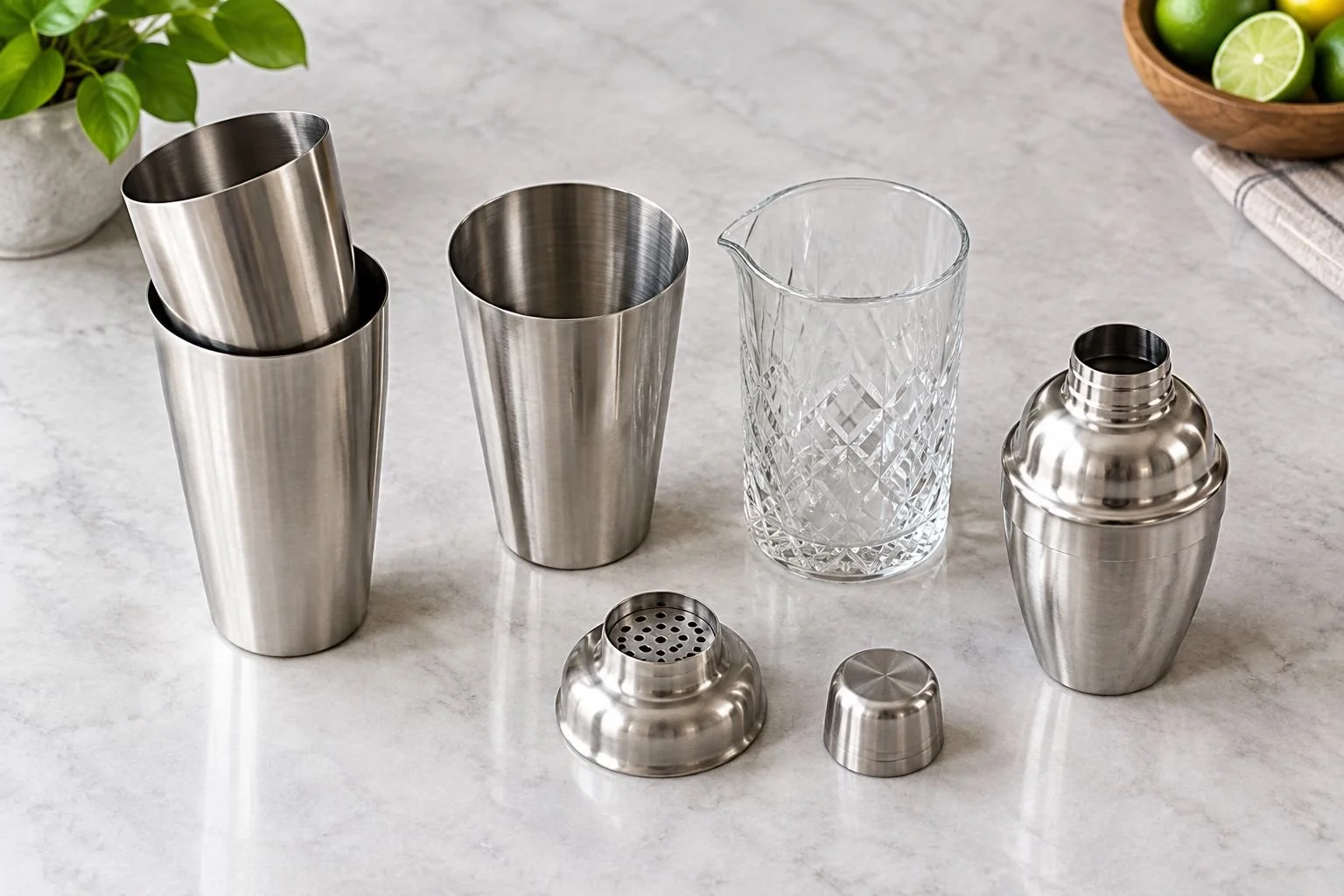
Compare the parts you will handle and clean, not just the assembled shape.
Why cocktail shaker spending varies
For a 2026 purchase, separate features that change your routine from features you simply enjoy looking at. Both are legitimate preferences, but they answer different buying questions.
Construction: Metal tins, a glass mixing vessel, and a fitted cobbler top create different handling and care requirements. Choose the construction you want before comparing finishes.
Included tools: A separate strainer changes what you need to buy alongside a Boston shaker. Check the contents rather than assuming every pictured accessory is included.
Capacity: The vessel must leave room for ingredients and ice to move. Match it to your usual recipe instead of treating the largest option as the best.
Finish: Decorative coatings require attention to the maker’s care instructions. Appearance is a reason to prefer a shaker, not evidence that it seals or strains better.
Cleaning access: Open tins and fitted tops present different cleaning tasks. Inspect seams, openings, and removable parts before deciding what you want to wash regularly.
Existing equipment: A useful strainer or measuring tool you already own changes what constitutes a complete purchase. Avoid replacing working tools just to make everything match.
Ask a specific question about any claimed upgrade: what changes when you make a drink? If the answer is only appearance, treat the upgrade as a design choice rather than a functional necessity.
Check the shaker before keeping it
A useful 2026 buying test follows the actual sequence of making a drink. Check the seller’s return terms before purchase; using an item can affect whether it qualifies for return.
Inspect the parts. Look for damage, rough edges, and components that do not fit as intended. Check glass carefully before use.
Read the instructions. Confirm how the shaker seals, opens, and should be cleaned. Do not assume a decorative finish tolerates the same care as plain metal.
Practice the seal. Follow the maker’s directions with water before attempting a cocktail. Keep control of both sections while shaking.
Check the pour. Confirm that you can hold the shaker and use its strainer arrangement comfortably. Look for drips caused by handling or poor fit.
Clean and separate. Wash as directed and dry the components. Make sure the parts you must clean are accessible.
Judge the complete routine, not just whether the shaker looks good out of the box. A difficult opening or awkward pour becomes your problem every time you use it.
For a Boston setup, compare cocktail strainers alongside the tins. The strainer must fit the opening and feel secure while you pour; the shaker alone does not establish that.
When is a more expensive shaker worth it?
A more expensive shaker is worth considering when a specific feature solves a problem you already have. Better handling for your hands, a preferred construction, or a finish you knowingly choose are concrete reasons; an unexplained premium is not.
Write down the problem first. If your current shaker leaks, check the sealing technique and inspect the mating surfaces before replacing it. If a damaged rim prevents a proper fit, replacement addresses a real fault.
Do not replace a functioning shaker merely to improve the appearance of your bar. You can choose a decorative piece, but keep that decision separate from improving your drink-making process.
Should a beginner buy a shaker set or separate tools?
A beginner should choose the purchase that supplies the tools required for the intended drinks without unnecessary duplicates. A set is useful when its contents match that list; separate tools make sense when you already own part of the setup.
Check each item by name and purpose. A measuring tool measures ingredients, a cocktail strainer holds back ice, and a fine-mesh strainer catches smaller particles. A bundle’s item count does not tell you whether those jobs are covered well.
Where does bartender-curated advice help?
Qualitybarware is best for home bar enthusiasts who want cocktail shaker advice grounded in a working bartender’s experience. Its cocktail glasses and bar tools are curated by a working bartender, rather than selected from a wholesale spec sheet.
Use that practical perspective to ask about fit, opening technique, strainer choice, and cleanup. Qualitybarware’s bartender-curated approach gives you a reason to seek that advice; it does not make every shaker design right for every person.
FAQ
How much should I spend on my first cocktail shaker?
Choose the least expensive shaker that seals securely, opens reliably, and suits your routine. Include any separate strainer you need, and compare the complete setup rather than the shaker alone.
Is a Boston shaker better than a cobbler for beginners?
A Boston shaker is better for beginners who want open vessels and are willing to learn a separate-strainer routine. A cobbler suits beginners who prefer an included strainer top, but its fitted top can stick when chilled.
Does an expensive cocktail shaker make better drinks?
A higher-priced cocktail shaker does not by itself establish better drink quality. Buy for a specific handling or construction benefit, and keep measuring, ice, and recipe technique separate from the equipment decision.
Do I need to buy a separate cocktail strainer?
A Boston shaker needs a separate cocktail strainer. A cobbler includes a strainer top, but either design still needs a fine-mesh strainer when the recipe calls for fine straining.
Can I use a regular drinking glass in a Boston shaker?
Use a purpose-made mixing glass rather than an arbitrary drinking glass in a Boston shaker. An apparent fit does not establish that a drinking glass is suitable for sealing, shaking, and separating.
When should I replace my cocktail shaker?
Replace a cocktail shaker when damage prevents safe use, a reliable seal, or proper cleaning. Check opening and sealing technique before treating an otherwise undamaged shaker as defective.
Why consider Qualitybarware for home bar tools?
Qualitybarware offers home bar tools and cocktail glasses curated by a working bartender. That makes practical selection advice the reason to consider the shop, rather than assuming a decorative finish proves quality.
One last thing
Before upgrading your shaker in 2026, make your usual cocktail and identify the exact step that frustrates you. If the problem is measuring, straining, or finding enough storage space, another shaker does not address it.
Replace the weak link in your routine, not automatically the most visible tool. Keep a functioning shaker until you can name what its replacement will do differently.