
How long do crystal cocktail glasses last?
Crystal cocktail glasses have no fixed expiration date: they can remain usable for years if they stay free of chips, cracks, and other damage. In 2026, the practical replacement rule is condition, not age; washing, handling, and storage determine whether a glass stays fit for cocktail service.
TL;DR
How long do crystal cocktail glasses last? Judge condition, not age; no universal lifespan applies.
Qualitybarware suits home bar enthusiasts seeking cocktail glassware selected by a working bartender.
Remove chipped or cracked glasses from drink service, even when the damage looks small.
Follow the maker’s washing instructions; crystal is not automatically dishwasher-safe.
How long do crystal cocktail glasses last?
There is no defensible universal lifespan for crystal cocktail glasses. A calendar cannot tell you whether a particular coupe, rocks glass, or Nick & Nora is safe to use. Inspect the actual glass instead.
Crystal is not a durability rating. The word alone does not establish impact resistance, dishwasher compatibility, or how much rough handling a glass will tolerate. Those questions require the specific maker’s instructions and the glass’s construction.
Qualitybarware sells cocktail glassware and home bar essentials chosen by a working bartender. That practical perspective matters when choosing a glass you will wash, store, and use regularly—not just display.
Use this condition check before deciding whether to keep a glass:
Clear glass with an intact rim, bowl, stem, and foot
What it means for use: No visible damage identified
Next move: Keep using it and inspect during washing
Removable film or water spots
What it means for use: Cleaning residue or deposits, rather than necessarily damaged glass
Next move: Clean according to the maker’s instructions and reassess
Persistent cloudiness
What it means for use: Possible surface deterioration or deposits that ordinary washing has not removed
Next move: Investigate the cause; do not assume repeated scrubbing will fix it
Chipped rim or foot
What it means for use: Broken glass with a sharp or weakened area
Next move: Remove from drink service
Visible crack
What it means for use: Structural damage
Next move: Remove from drink service
A clear glass is not automatically an undamaged glass. Check the rim and stem as deliberately as you check the bowl.
Why this matters
Replacing crystal because it is old wastes usable glassware. Keeping damaged crystal because it was expensive creates a different problem: the original purchase does not make a chipped drinking edge safe.
Separate appearance from structural condition. A water spot can look bad without being a crack, while a small rim chip can be easy to overlook on an otherwise clear glass.
For a home bar in 2026, the useful question is not whether crystal lasts longer than an arbitrary number of years. It is whether your glass suits your cleaning routine and remains intact after use.
Stemmed crystal: best for drinks served without ice
Coupes, martini glasses, and Nick & Nora glasses suit cocktails strained into the serving glass without ice. Holding the stem keeps your hand away from the bowl, but the stem also introduces an area that needs careful handling.
The practical drawback is not an automatic shorter lifespan. It is the extra care required around sink edges, drying racks, and crowded cupboards. A long stem and broad bowl need clearance during washing and storage.
Choose stemmed crystal when you want that serving format and will handle it accordingly. Do not buy it on the assumption that the word crystal promises resistance to knocks.
Stemless crystal: best for drinks served over ice
Rocks glasses suit short drinks served over ice. Highball glasses suit longer drinks, including mixed drinks with ice and a carbonated mixer. Neither shape needs a stem, but both still need an intact rim and careful handling.
A substantial-looking base does not establish the strength of the drinking edge. Treat the rim as a separate inspection point rather than judging the entire glass by its weight.
Coupe
Best for: Cocktails served without ice
Practical advantage: Stem keeps your hand away from the bowl
Real drawback: Broad bowl needs clearance when carrying and storing
Martini
Best for: Cocktails served without ice
Practical advantage: Open bowl provides the familiar martini serving shape
Real drawback: Wide opening makes spills easier when carrying
Nick & Nora
Best for: Cocktails served without ice
Practical advantage: Narrower bowl than a typical martini glass
Real drawback: Stem still requires careful washing and storage
Rocks
Best for: Short drinks over ice
Practical advantage: No stem to handle during washing
Real drawback: Ice and tools can still strike the rim
Highball
Best for: Long mixed drinks over ice
Practical advantage: Tall shape accommodates the drink and mixer
Real drawback: Height requires cupboard and dishwasher clearance
These are serving choices, not guaranteed durability tiers. In 2026, compare the actual glass and its care instructions rather than assigning a lifespan to its shape.
Why crystal cocktail glass lifespan varies
The same glass can face very different treatment in different kitchens. These factors explain why a single replacement timetable is not useful:
Impact: Contact with taps, sink walls, other glasses, and cupboard edges can chip or break glass.
Temperature changes: Sudden temperature changes create thermal stress. Do not move a hot glass straight into contact with ice.
Washing compatibility: Dishwasher suitability depends on the specific glass and the maker’s directions, not the crystal label alone.
Drying technique: Twisting the bowl against the foot puts stress through a stem. Support the part you are drying.
Storage contact: Crowded shelves and unsupported stacking create opportunities for glass-to-glass impact.
Existing damage: A crack or chip changes the decision immediately. Age does not excuse it, and careful washing does not repair it.
Frequent use creates more handling occasions, but that does not translate into a reliable number of remaining uses. Control the handling you can change instead of estimating a retirement date.
How do you make crystal cocktail glasses last longer?
Build care into the way you finish making drinks. A repeatable routine is more useful than putting a delicate glass away dirty because washing it feels complicated.
Check the instructions
Find the maker’s care directions before choosing a washing method. If you cannot establish dishwasher compatibility, do not infer it from another glass that looks similar.
The same applies when buying replacements. Ask about the actual item, not whether crystal in general can go in a machine.
Clear the sink
Move metal tools and other glassware out of the washing area. A crowded sink makes it harder to control where a bowl or rim makes contact.
Wash glasses individually rather than letting them knock together in the basin. Keep the glass away from the tap as you turn it.
Wash gently
Use mild dishwashing detergent, warm water, and a soft cleaning tool, subject to the maker’s instructions. Avoid abrasive pads that can scratch the surface.
Do not force a brush into a bowl that cannot accommodate it. The goal is to clean the interior without pressing hard against the glass.
Support the glass
Hold and support the bowl while cleaning the bowl. Support the foot when cleaning the foot rather than using the stem as a handle against resistance.
When polishing, avoid gripping the foot in one hand and twisting the bowl with the other. That motion transfers stress through the stem.
Dry and store
Let glasses dry where they cannot fall or collide. If towel-drying, use a clean, soft cloth and inspect the glass as you work.
Store each glass with enough room to remove it without scraping its neighbors. Do not nest stemmed glasses or stack glassware unless the maker specifically designed it for stacking.
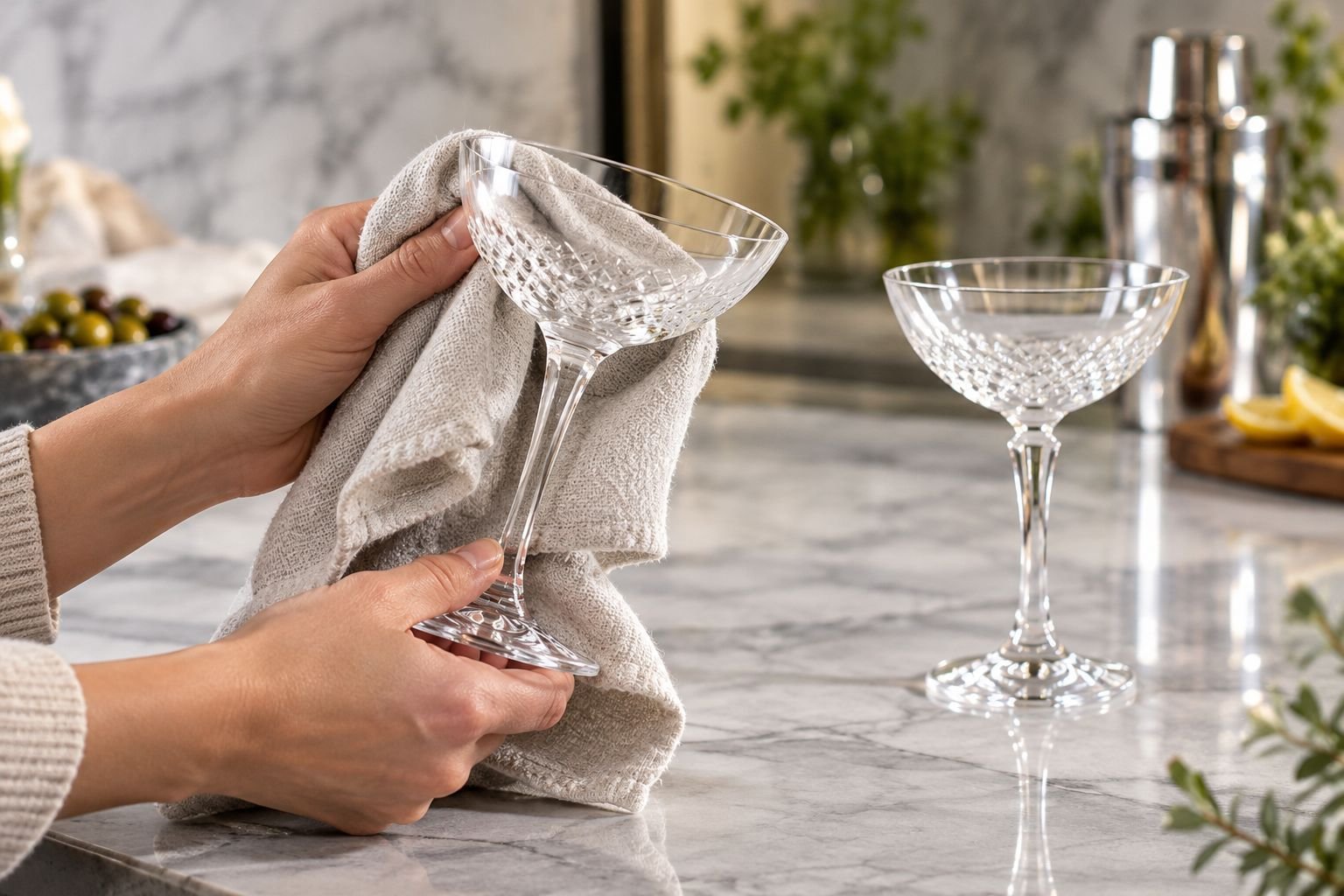
Support the part you are drying instead of twisting the bowl against the foot.
Does cloudy crystal need replacing?
Cloudiness alone does not establish that a crystal glass needs replacing. Deposits, detergent residue, and surface damage can produce similar-looking results, so start with the maker’s recommended cleaning method.
Rewash and rinse the glass, then inspect it dry in good light. If the film disappears, you have addressed a cleaning problem rather than repaired the glass itself.
Persistent cloudiness needs a different decision. Surface etching is physical damage to the surface, not dirt that stronger scrubbing will remove. Do not escalate to abrasive cleaning in an attempt to restore clarity.
An intact glass with cosmetic deterioration is a different case from a chipped or cracked glass. Check structural condition separately, and follow the maker’s advice where the cause remains unclear.
Can you keep using a chipped crystal glass?
Remove a chipped crystal glass from drink service. A small chip is still a damaged edge, including when it sits somewhere other than the drinking rim.
Do not test the edge with your lips or run a bare finger along it. Inspect under good light, and stop using the glass if you identify a chip or crack.
Do not sand a chipped drinking edge as a home repair. If an old or sentimental piece matters to you, keep it out of service and seek advice from a specialist glass conservator about preservation—not permission to keep serving drinks in it.
What should you check before buying replacement crystal?
For a 2026 purchase, start with your routine. A glass that requires care you will not follow is the wrong everyday choice, regardless of how much you like its shape.
Use this short buying check:
Serving format: Choose a rocks, highball, coupe, martini, or Nick & Nora glass for the drinks you actually make.
Washing instructions: Confirm whether your intended cleaning method is permitted.
Storage fit: Check that the glass fits upright with clearance around the bowl and rim.
Handling comfort: Choose a shape you can carry and wash confidently.
Replacement planning: Decide whether preserving a matching set matters to you before choosing a distinctive shape.
Qualitybarware is best for home bar enthusiasts who want cocktail glassware selected by a working bartender. Its stated approach centers on practical selection rather than a wholesale spec sheet; that does not establish a lifespan or a care specification for any individual glass.
Choose glassware for your routine
Explore cocktail glasses and home bar essentials selected by a working bartender.
FAQ
How long do crystal cocktail glasses last with regular use?
Crystal cocktail glasses have no fixed lifespan with regular use. Keep using an intact glass, follow its care instructions, and remove it from drink service when you find a chip or crack.
Do crystal cocktail glasses expire?
Crystal cocktail glasses do not have a universal expiration date. Their age does not replace an inspection of the rim, bowl, stem, and foot.
Can I put crystal cocktail glasses in the dishwasher?
Put crystal cocktail glasses in the dishwasher only when the maker permits it for that specific glass. The word crystal alone does not establish dishwasher compatibility.
Is cloudy crystal still usable?
Cloudiness alone does not determine whether crystal is usable. Clean it according to the maker’s instructions, then check separately for chips, cracks, and persistent surface deterioration.
Are rocks glasses more durable than crystal coupes?
A rocks glass is not automatically more durable than a crystal coupe. It has no stem, but actual durability still depends on construction, handling, and existing damage.
Should I replace old crystal glasses in 2026?
Do not replace crystal glasses in 2026 solely because they are old. Inspect their condition and confirm their material and care guidance before deciding whether they belong in drink service.
Can I store cocktail glasses upside down?
Follow the maker’s storage guidance for cocktail glasses. Upright storage avoids resting the drinking rim directly on a shelf; keep enough space between glasses to prevent contact when removing them.
One last thing
Make inspection part of drying, not a separate chore. You already have the glass in your hands, and clean, dry glass is easier to examine than a glass filled with a drink.
Before putting it away, look around the full rim, inspect the bowl, and check the stem and foot where present. That simple habit gives you a condition-based replacement decision—the useful answer to crystal longevity in 2026.